Showing posts with label Book of the Week. Show all posts

Monday, January 3, 2011

I also read books

So, in addition to watching much tv, I also managed to read a couple books over my break, most particularly this one, which was a present from Hedgehog:


I'm sure I've written about an Isabel Allende novel before, since I lovelovelove her, and her books are the kind where you might actually learn something, or at least you will if you know practically nothing about what she's writing about, like I do. This one is about Haiti and a little about Cuba and also about New Orleans, all in the late 18th and early 19th century, and the only historical thing I actually knew going in was that at some point there would be something called the Louisiana Purchase, which is what made most of Minnesota part of the United States, so there's that. Because I'm really bad at history and stopped paying attention to it sometime in Junior High, it had never exactly occurred to me that lots of people were living in those areas at that time, and not everyone was necessarily happy about it. Imagine that. Some people would actually rather be French.

Anyway, that's not at all the point of the book, just a little aside that makes me sounds stupid, which I know you all like. The point of the book is more or less about freedom and humanity, or lack thereof and of course about race and what defines it and what it means and all that. It's very very good and so you should take my recommendation for once and go read it.


Friday, July 24, 2009

A book, a movie and other random thoughts

So, with all the moving about and unpacking of seventeen boxes of knick knacks and random wires, I've been behind on the reading and watching of new movies lately. On the other hand, we have absolutely no reception on our tv in here (even with a fancy digital to analog converter box of the future), so I have been rewatching all the old standards about fifty times a day. If I didn't have "Super Troopers" memorized before, I definitely do now.

We did finally find our Netflix movies yesterday, though, and watched "The Believer*," which is an uplifting little film about a Jewish Nazi. I learned three things from this movie. Number one, I think that neo-Nazis just like being angry. Otherwise, why live in New York and take the subway, where you're destined to run in to Jewish people and black people and Asian people and all those folks who send you into a murderous rage? You could move to a small Nebraska town and just never ever have to deal with it. Obviously, they have not been attending their yoga and meditation classes.

Second, and I should probably get myself checked out for this, but I still think Ryan Gosling is hot, even when all Nazi'd out. Ok, not a big fan of the swastika shirt, but the shaved head is kind of sexy. Is this a problem I should worry about?

Third, it turns out there are movies that can have an ending that I will not ruin for you, but I will warn you is not all puppy dogs and light, but is about the best of any possible world you could imagine for the character anyway. That's vague, but you should watch it because you won't cry and get as depressed as you might think you will. On the other hand, if you're like me, you will have dreams that night about killing people and then wandering the streets naked.

Your book recommendation this week is much less disturbing, even though the author died of heroin-addiction-related illnesses before his novel was published. It's called "2666," and it's by Roberto BolaƱo. For this week, I just recommend the first section: "The Part About the Critics," mostly because that's the only part I've read yet. This first part is about four academics (three men, one woman) who all translated the work of a German author called Archimboldi into their own languages (English, Spanish, Italian and French) and wrote other critical essays on his work, and thus met at boring academic conferences. The woman and the French and Spanish men each carry on ill-fated relationships, including at least one threesome, before they travel to Mexico to find Archimboldi, whom no one has seen in years, but they hear he's hanging around some rural area where a lot of young ladies are being killed. While the French and Spanish man chill in Mexico, the English woman goes back to Italy and starts shit up with the other man and thus ends part one. There's some other shit that happens too probably.

So, try it, you'll like it. It has some old standby themes of narrator unreliability, the inconstancy of man and the role of the external in identity construction. That sounds smart, right? It's also written very straightforwardly (for example, he'd never use the word "straightforwardly" probably) and pulls you into the story very quickly. So get on that and get back to me.


---
*Not to be confused with the magazine, which I have a subscription to, and enjoy explaining to people trying to sell me magazines over the phone, since it's actually a literary magazine and has nothing to do with God or Jesus or Nazis either.


http://irregulargiggling.blogspot.com

Thursday, June 18, 2009

I was the smartest little white kid ever

Your book of the week this week is any collection you so choose of Edgar Allan Poe stories. The one I happen to be reading is called "Tales of Mystery and Imagination" and is leather bound and has one of those paper covers that started falling off right away and it doesn't even have a copyright date in it, but it has a pencilled in inscription with the price of 25 cents, so I'm guessing it's kind of old. Anyway, I don't know where this particular collection came from in our bookshelf, but I chose it because it's the one I haven't read, even though there are four others in our shelf I have read, and about half of the stories in this one I had already read, because I was a really really morbid child, as you probably figured out from this Way Back Tuesday installment. Anyway, in addition to reading all about real-life serial killers, I also liked reading about imaginary serial killers and other things that go bump in the night, so some of my favorite authors between the ages of about ten and fifteen were Stephen King, Bram Stoker, and Edgar Allan Poe. Re-reading Stephen King and Bram Stoker in adulthood I've realized that they were pretty gorey and I was a pretty sick kid. Re-reading Edgar Allan Poe I've realized that he's a fucking damn good writer and I was a legitimate genius.

Case in point, The Pit and the Pendulum, which was a personal favorite of mine, and which I had in a smaller collection along with The Gold Bug and The Raven and I liked to re-read on rainy, stormy days:

I was sick--sick unto death with that long agony; and when they at length unbound me, and I was permitted to sit, I felt that my senses were leaving me. The sentence--the dread sentence of death--was the last of distinct accentuation which reached my ears. After that, the sound of the inquisitorial voices seemed merged in one indeterminate hum. It conveyed to my soul the idea of revolution--perhaps from its association in fancy with the burr of a mill-wheel.
And, yeah. I was twelve. I wish I had continued along the same trajectory of smartness growth. Judging from that sentence I'd guess I actually went along some sort of parabola, and I'm on the downward part now.

But maybe there's still hope for you guys, and if you read some Poe you could get smarter. And more murderous. Let's build a band of murderous geniuses!

---


Wednesday, June 10, 2009

Dirty Stinking Socialists

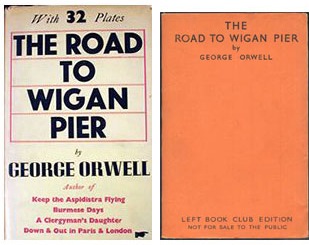
That's right, it's Book of the Week time, and I've been reading about the dirty commies again:


The good thing about George Orwell, compared to the other anti-American types out there, is that he's a very engaging writer and actually makes you care about the plight of the average miner and the unemployed in England in the 1930s. He also is capable of recognizing the problems with "his" political party and engages in a good run down of both why the upper class in Britain think the poor smell bad, and why they think that Socialists are assholes. For some reason he doesn't engage the issue of Socialists smelling bad, but maybe that's a modern phenomenon unique to skinny white kids on college campuses.

It reminded me a little of The Jungle, which is certainly not the most imaginative comparison ever, since they're both socialist writers writing about the disgusting conditions faced by the working class. The Jungle put me off meat since high school, and now I'm definitely not going to be using any coal any time soon. Except for when it's used to make my electricity and heat. I need those things so I won't smell like a socialist.

Ok, for your last word you get one clever moment of English Major Interpretation: the title is "The Road to Wigan Pier", but Orwell points out early on that Wigan Pier (as such) no longer exists. So the book is about how being in the working class is a road to Nowhere. Get it? Yeah, I'm smart. They didn't even mention that on Wikipedia or nothing.


---

Wednesday, June 3, 2009

Murder is hot

It's been awhile since I've done a "Book of the Week," and not because I haven't been reading books every week but because I have lost faith that you, Internet Readers, give a shit about the downfall of our society, and reading the comments on The Onion AV Club articles that invariably include eight misspellings, four grammatical errors and at least twenty words stripped of their vowels to "save space," is not helping.  

But you know what?  Fuck you.  I'm going to tell you about books anyway.  Cause why?  Cause Fuck You, that's why.

So, go read a collection of short stories by Flannery O'Connor.  It will make you depressed and hate humanity for reasons completely separate from their low educational attainment.  You will meet all kinds of lovely characters who come from the southern marshes and know the difference between white trash and good folk and have Christ on their side.  I just recommend that you don't open your book to the story entitled "The Artificial N-Word*" while on the bus because all of a sudden your self-important white ass will find it necessary to flip very quickly to another page to prove you're not a racist to the completely oblivious person next to you.

When you're done with that, you should read "I Am No One You Know," by Joyce Carol Oates, and see another side of depressing, from a more Northern point of view.  Then, you'll be caught up with me just in time to buy Oates' fictionalized biography of Jeffrey Dahmer, which I am looking forward to in what is probably an unhealthy way. 


---
* Surprise, surprise, the actual N-word appears in that story title, as well as peppered throughout many of her stories, but I am absolutely constitutionally incapable of even typing it, which does not in any way make me less racist, just more paranoid, and tending toward imbuing words with their own magical powers.


Wednesday, May 13, 2009

So he says, "Have sex with her on the floor of a gas station bathroom? I don't even know 'er!"

So, a photographer is coming to take pictures of our apartment to put it on the market this afternoon, and as a result I've done things like clean the windows and dust the walls and de-fur everything in the house over the last week, and as Houseboy pointed out (with a total lack of irony), our apartment is now the cleanest it's been since we moved in.  I also was asked by our realtor to "declutter," so there are about 10 boxes of books and knick knacks in our storage container(s) in the basement and I'm thinking maybe I have a clutter "problem."

Anyway, all of that is a very astute introduction to this week's book, "Bend Sinister," by Vladimir Nabokov*, which I have in such an old edition that none of the google images shows the cover I have, which fell off while I was reading it and I used it as a bookmark.  So, anyway, my edition also has an introduction in which they quote Nabokov saying that everyone took the book rather too seriously the first time around and looked for hidden meanings where there were none.  That pretty much gave me the carte blanche to just read it and enjoy it, since Nabokov writes in his second language at least three times better than the average writer in his first.  I had a whole bunch of good quotes underlined for you, but I already packed the book away, so you'll just have to take my word for it.  So, possible deeper meaning aside, this book takes place in a fictional Eastern European country, where the new government is one of those fascist/communist ones that were so popular in that region at a certain time.  The main character is a famous philosopher (Adam Krug) whose wife has just died of natural causes, leaving him alone with a very young son.  He has no interest in getting involved in the political hullaballoo, but he's famous and plus the dictator is an old school chum that he nicknamed "The Toad," and on whose face Krug repeatedly sat when they were children.  So The Toad's henchmen keep trying to get him to sign things and give speeches and he keeps going out to country houses to stay with friends, who are then arrested by a couple who fit the Communist/Nazi stereotype used so often in Indiana Jones and Wonder Woman--clean and fit and completely self-absorbed, they have conversations about their sex life while carting folks off to the gulag.  

So, despite all his friends disappearing, Krug is more or less winning this battle since he remains calm and unaffected and doesn't sign any "The Toad is Great" documents, until they arrest him and kidnap his son and then shit gets emotional**.  All in all, without looking too deeply, there are some definite anti-totalitarian vibes and some intellectual freedom stuff and definitely a whole pro-family message.  And that's all I'll say on that.  Go read it.  It's good.  And this one doesn't even have any sex with little girls in it, I promise.


---
* Think about it hard and you'll figure it out.  Take the day off if you have to.
** Yeah, that's an Idiocracy reference.


Thursday, April 16, 2009

Books are Boring

So, I haven't had a book blog in awhile because I keep running into duds.  This is another side effect of just reading your way alphabetically through a shared collection of books.  Sometimes you end up on the bus going "Really?  Really?  Why the fuck do we own this crap?"  And since I hate being a hater*, I'm not going to tell you about all the ones I read and hated.

Except for one, because the author is long dead and everybody thinks they're so great if they read it, but you should just know it sucks before you head into its blank verse nonsense.  It is "Paradise Lost and Paradise Regained" by John "fuckface" Milton.  Now, the first problem with this book/these books is that it is (as mentioned above) written in blank verse.  That means high-falutin' craziness to all you illiterates out there.  Personally, I have liked other things written in blank verse.  I have even occasionally enjoyed the sort of lulling rhythm of it.  In this case, though, it just about put me to sleep (and I know that's blasphemy to say about Milton, but it's not like you all have a leg to stand on in criticising me, so back the fuck off).  

Anyway, the only thing that saved me from actually nodding off on the bus while reading this was Milton's intense hatred of women and radical and heretical interpretation of scripture.  First, according to Milton, The Fall happened because, even though they had been warned about Satan (which Eve overheard because she was eavesdropping instead of fetching the food like a good woman should), Eve suggested that she and Adam split up and tend to the weeding in different parts of the garden.  Then, she is accosted by the snake, who is super happy to see the weaker of the pair alone and unguarded.  The snake says all kinds of flattering things about her, which she especially likes since she and Adam just had a fight about how she's not smart or strong enough to go off on her own.  The snake also tells her that the reason he can talk is because he ate the fruit of the forbidden tree, which makes Eve want to eat it, even though she can already talk, because we know how the bitches like to gab, am I right?

All that so far is a somewhat sexist interpretation of scripture, but not TERRIBLY far off what's in the Bible.  Now is when it gets downright ridiculous though.  Eve brings the fruit to Adam, who knows it's forbidden and doesn't want to eat it, but he's so sad that Eve has been condemned to Hell that he decides to sacrifice himself for her sake and eat it so that she won't be alone in damnation.  Such an upstanding guy, this Adam.  Not to mention that, when God realizes what they've done, there is a small amount of recrimination, but it's mostly on Eve's part, who basically devolves into a crying little girl while Adam takes the punishment like a man and explains to Eve that they deserve it, and they'll just have to put their hope in the future.

So, Paradise Regained.  About 9/10ths of the book was the Paradise Lost part, and it only takes a little while to win it all back by betting on Jesus.  I guess his story just isn't as interesting.  Which makes sense, since according to Milton, God created Jesus sometime before Adam and Eve, and his only real role in the beginning was to make Satan jealous and precipitate his fall and the creation of Hell.  Way to go Jesus.  Thanks for that.  On the other hand, he does petition his dad to let him come down to Earth and save all our souls, which was nice of him.  

Close observers will notice that all this is complete heresy, seeing as how 1) God did not "create" Jesus, 2) There was no "time" where God existed and Jesus didn't and 3) I'm pretty sure God and Jesus don't have disagreements or argue about shit.  Not to mention that popular lore has it that Satan fell out of jealousy over the creation of humans, not jealousy over Jesus, which would be jealousy over God which is some kind of time warp vicious cycle nonsense.  

Okay, so don't read Paradise Lost or Paradise Regained, because even though I know I made it all kinds of fun, 400 pages of that is just not.  


-------
* Obviously I don't hate being a hater, but I do feel bad saying mean things about books, since they're really super hard to write and I've never done it, plus there's the whole "eye of the beholder" aspect, so I'd just as soon not be a bitch about it.  Most of the time.

Friday, April 3, 2009

Saying a Fan is No Good, Just Because You Can't Use It As a Vacuum Cleaner

The title today is a new phrase I invented my very own self that I hope all of you will add to your arsenal immediately.  

Example:

"That guy is an asshole.  How could he even tell if other people are assholes?"

"That's like saying a fan is no good, just because you can't use it as a vacuum cleaner.  He has a perfectly good asshole-detector.  He just can't turn it inward."


Yeah, like that.

And with no segue at all, that brings us to this week's Books of the Week.  Yes, yet again I have read TWO books this week, and you have to suffer through hearing about them both.  The week began with The Little Sister, by Raymond Chandler, featuring (as they always do) the six foot tall sarcastic detective, Philip Marlowe.  Since hearing that Clive Owen bought the rights to all the Marlowe books, I can't help but picture him as the main character, which wasn't an altogether unpleasant experience:


So, since I imagine you don't read Raymond Chandler, since you don't read anything because you went to public school, I suppose I ought to tell you a thing or two about the book and the writer. 
  1. They are good
  2. Marlowe is irresistable to the ladies (I dare you to resist)
  3. They are good
Raymond Chandler fits well into the noir genre, and even Marlowe seems aware of that fact.  In The Little Sister he more than once warns other characters that they are dealing with real life, not the stuff of a pulp novel, shortly after which he either gets shot at, has a woman swoon in his arms, or lights yet another cigarette.  If you think you might like that, this is a good novel to start with, since it doesn't have any homosexual or "ethnic" characters to act ridiculous and detract from the fun of the mystery*.  

Book number two this week is a collection called The Best American NonRequired Reading: 2007, which I bought when we went to Barnes and Noble to buy a DVD, because I'm physically incapable of leaving a bookstore without buying a book.  This was a good choice, since it's edited by Dave Eggers who is my secret best friend, and secret best friends are better because then only you know how bestest friends you are.  

Overall the stories and essays in this were fantastic.  The only one I wasn't particularly enamored with was the last, entitled "Literature Unnatured," by Joy Williams.  Maybe my attention span was just waning at the end of this long collection, but I got bored early on and decided that it was yet another example of a Baby Boomer bewailing the fall of culture since their awesome generation, which I seem to be encountering a lot of lately.  Again, it may be my age and status as the child of a Baby Boomer, but when they bewail it bothers me much more than when others bewail.  

But that is a topic for another day, this has gone on long enough.


------
* This is meant to be a comment on the existence of stereotypical characters in other noir novels, not a statement that I think homosexual and ethnic people are ridiculous.  I think all people are ridiculous, no matter their race or sexual orientation.


....

Wednesday, March 25, 2009

One Hundred Blogs of Solitude

Welcome to the 100th post, ladies and gentlepersons!  I should try to make this a good one.  

What is good/funny/interesting that I can tell you?  Let's start with books! I participated in this Facebook meme "100 Books," which claims that, according to the BBC, the average person will have read only 6 books on the list.  Because there are few things that I love more than feeling superior to the British, I made my little check marks and came up with 53.  So far second only to Houseboy's college roommate in total number.  After I did it, so did Soda Pop, and she seemed to think that you're allowed to put a 0.5 next to things when you started reading them on my recommendation and then stopped halfway through and will tell people all the time about how much you hated it.  In that case, I should really get 53.5 because I tried reading the Bible once, and also I hear selections from it every Sunday when I'm paying attention.  But no, I'm not a cheater like that.  Anyway, the list is pretty much bogus, since there are overlaps and repetitions and also you only get one check for reading "The Complete Works of Shakespeare" and one for reading "The Lion, The Witch and the Wardrobe," which is a great book, but only like 100 pages.  It fulfilled its purpose, though, as I feel smarter than almost everyone, except my Korean friend who read like 43, and should get double points since it's not her native language.

This same friend also once came to my house for Halloween, and we proceeded to get more than sloppy, and I will never ever recover from the amazement at her ability to continue to speak English as she passed out on our couch.

In other news, I did 20 crunches yesterday and today I can barely sit up.  I'm getting old, folks.  There was a time when I could do hundreds, and then go swim two miles and then run 10 miles and then wrestle a cougar.  Sadly, I killed all the cougars and now I'm out of shape.

Speaking of being old, I watched Garden State last night, which I own and I love, but has evolved over the last few years in how I relate to it.  When it came out I was about the age and life-stage of the characters, and I thought the Natalie Portman character was just about the coolest thing ever and I wanted to scream into the infinite abyss and all that.  Now when I watch it I get nostalgic for a time when I gave a shit about stuff, and I think the poor Natalie Portman character has a lot of issues she needs to work out, and I still want to scream into the infinite abyss, but it would probably be unseemly for a woman of my age and position.  

So, that's about all for the 100th blog of all time, here's hoping we make it to 101.


...

Monday, March 23, 2009

Spidercat! Spidercat! Does all the things that a spidercat does!

This morning Houseboy and I took the Neurotic Cat into the vet specialist way out in Buffalo Grove, Illinois to turn him radioactive.  Apparently they blast him with some kind of isotopes and that will make him less angry and pukey and skinny butt-ed.  On the way out there I let him out of the cat carrier and he puked, looked out the window for a really long time, and then made a break for it, via the back of Houseboy's head.  

Also on the way up and back, I paid a dollar (each way) to drive on the absolute worst stretch of road (not counting the Pennsylvania Turnpike which isn't really a road so much as a state-sponsored death trap) that I've ever had the pleasure of paying for.  It was actually amusing how as soon as we passed the tollbooth, it went from nice pavement to bomb zone.

That's as much of a segue as you're going to get into this week's reading, featuring: Anarchy!  First, I read an article in The Believer from some other month that is not this one, about a guy going undercover with the Anarchists who were protesting the Republican National Convention in Minnesota last year.  From this I learned what I already know: southern Minnesota is mostly corn and water towers, anarchists do not bathe as regularly as the rest of us, and the Anarchy Movement is kind of an oxymoron.

Similarly, A Girl Among the Anarchists, which was originally published in 1903, didn't really challenge my assumptions about Anarchy or Anarchists.  Most of the "characters" (this is loosely based on the real lives of Helen and Olivia Rossetti) are doing very little outside of writing and publishing tracts on Anarchy and debating with one another what Real Anarchy is and occasionally stealing shit because ownership of property is a false construct, or somesuch.  About 2/3 of the way through the book, the "Girl" of the title somewhat ironically lays out exactly what I see as the problem with Anarchy.  She is describing two brothers who stole all their employer's money and took off with it, because 1) they don't recognize private property, and 2) they needed it.  The employer then shot himself:

What they lacked was moral strength.  Under ordinarily good influences they would have acted in an ordinarily proper way.  They had not the force of character necessary for handling the Anarchist individualist doctrines, which, excellently as they may work with men of character, are fatal to weaker men.
(p. 206)

It seems obvious to me that not everyone would act in a moral or thoughtful way if they were left to their own devices.  If completely "freed" from  any understanding of obligation to our fellow man, how many of us would still feed the poor or refrain from stealing whatever we want, or even pause at a stoplight?  Maybe I have a lower view of human nature than Anarchists do, but it seems to me that she is here acknowledging that issue.  And as long as there are some who cannot handle "the Anarchist individualist doctrines," then it's a system that cannot work, because it is a system without any recourse or solution for those who don't fit in.  In fact, it's not a system at all.  


...

Thursday, March 19, 2009

My Headband is Squeezing my Brains Out

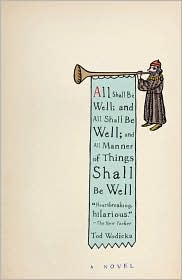
Being on a plane once again this week, plus just generally being more smarter and more hard working-er than the rest of you, I have several "Book[s] of the Week" to choose from today.  Do you want to hear about "Girl Among the Anarchists," which I started first, but am only 2/3 of the way finished because other books got in the way?  Or would you like to hear about "The Enchantress of Florence," Salman Rushdie's "new" book, which was the only Rushdie they had for sale at BAM! Books a Million! which is across the street from my office and is a miserable rotten bookstore for that?  Or, how about "All Shall Be Well; and All Shall Be Well; and All Manner of Things Shall Be Well," by Tod Wodicka, which proves that picking books based on starting from the end of the alphabet in a Barnes & Noble and looking for great titles will really pay off?

Cast your ballots!

.
.
.
.
.

Ok, votes are in, I'm going to tell you about the last two, since I've actually finished them.


The Enchantress of Florence came out in 2008 (oh, those halcyon days), and I meant to buy it right away, even in hardcover, even if it put my reading out of order... but then I didn't.  Don't I tell great stories?  

Anyway, a quick glance at Rushdie's Wikiwikiwhat page shows me that I've read every novel he's ever written, and gotten a start on the short stories as well.  That should make me a Salman Rushdie Expert, but instead I think it just makes me almost incapable of reviewing anything by him.  I'm actually a Salman Rushdie Psycho Fan, and I may or may not own a pair of Salman Rushdie Pajamas that I wear under my clothing at all times.  So, you have permission to ignore me when I tell you that this is the most awesome novel you will ever read, and even if you're not stuck on a bus or train or plane, you will read it all the way through as fast as you can and then wish you had read it more slowly.  You will carry it around with you and whip it out at your in-laws place, ignoring normal social mores around helping with the dishes, because You Are Busy.  When it is finished, you will dream about Qara Koz, the semi-mythical "hidden princess" aka Lady Black Eyes, aka Angelica, and the traveller/storyteller Niccolo Vespucci, aka Ucello, aka Mogor dell'Amore ("The Moghul of Love").  If you haven't already, you will then quickly lay siege to every other Rushdie novel ever written and find them all to be just as wonderful.

Tod Wodicka, on the other hand, while certainly Pajama-worthy, I had never heard of before I read this book.  I don't feel too bad about that, since even ol' Wiki barely has a stub article on the guy, and his bibliography seems to be only this novel.  For first novels, it's a pretty damn amazing achievement.  For not first novels it's fantastic, in fact.  It follows Burt Hecker, aka Eckbert Attquiet (I'm all about the "aka" this week), who is a medieval re-enactor, father of two, semi-recent widow, and possessor of a nose whose description becomes like a good horror movie's monster: much worse in imagination than it could possibly be in life.  Burt is, quite simply, going off the deep end before the novel begins, and the narration jumps around a bit in his life to help explain why.  What it does well that other novels have failed at, is building a sympathetic character out of a pile of disgusting and laughable attributes.  Although his medieval obsession can be funny, it's never played for laughs.  While his children hate him, and he's always drunk on mead, and for some reason I get the impression he has terrible body odor, you still want him to be your friend--or at least to invite you to the annual revel at his wife's mansion.  

So there you go: two more novels you should feel bad about not reading.  Tune in tomorrow when I tell you about seeing the Pogues live in concert and maybe even upload a video shot using cell phone technology circa 2006.  Yay!


...

Tuesday, March 10, 2009

Alcoholism is not all fun and games

So, continuing in my trend of reading about drunken Irishmen, this week I read "Charming Billy", by Alice McDermott:


This is one of those casualties of reading the books in your bookshelves in alphabetical order by author.  Sometimes you end up reading several books by the same person in a row, and then moving on to another person whose name starts with "Mc," and so is likely to have similar subject matter.  This is also the casualty of living with a Catholic: that your bookshelves will have a disproportionate number of Irishmen and women in them.  It has something to do with the perpetual virginity of Mary, I think.

Anyway, Charming Billy Lynch is an alcoholic who drinks himself to death, much in the style of the father in Angela's ashes, only he's not poor, holds down a job and doesn't have any children, so really it's not so bad.  All his friends are mad at him all the time because they think drinking yourself to death is a bad thing, but they also think he's charming and like hanging out with him in bars.  Even with the occasional misty water-colored memory of his father by Frank McCourt, Malachy McCourt isn't exactly charming the way his drinking results in them eating nothing but berries found on the side of the road for a week.  

All in all, if I have to rate them (which I do, because I read them back to back and I'm incapable of not comparing things that are practically rubbing elbows), I preferred Frank McCourt's memoirs.  Alice McDermott's style is much more descriptive and I really loved how detailed she got sometimes, but I also found her occasional use of repetition to be distracting.  Plus, I'm just a sucker for the extreme poverty and abuse stories, and even a bloated body found on the street doesn't quite make up the difference.


...

Friday, March 6, 2009

Ireland is a sad, sad place

And so was New York in the 1950's and 60's, but not quite as bad.  This is the lesson I learned from this week's Books of the Week:


This is an important lesson, because I visited Ireland once, and I didn't see the sadness.  Also, it was important because I started "Angela's Ashes" thinking it was about the Holocaust, and I think we all know by now that, while I find the Holocaust really, really horrible, I'm about done with learning about it for now.  I don't think I can get more sad about that.  Luckily, this book was, as I have mentioned, about how sad the Irish were, around the same time.  

These two are memoirs that are basically directly in a timeline together, so make sure you read "Angela's Ashes" first, or you might not have quite the basis in sad Ireland that you need to understand sad New York.  Anyway, Frank McCourt grew up about as poor as is humanly possible, as proven by the fact of several younger siblings dying of poverty-related illness, and him subsisting on nutrition found in fish and chips containers left on the street.  I don't want to give away too much, but pretty much every hopeful moment that is going to drag them out of crushing despair ends in tragedy, but it's still a fun read.  I promise I don't take pleasure in the misfortunes of others.  Mostly.  

Also, it's probably not revealing too much to say that the exception to the crushing despair and tragedy formula applied above involves Frankie going to New York and, while not "making it big" at least "making it well-fed and sheltered from the cold," which is a giant step up.  There's a third book in this series that I haven't read yet, so maybe that's when he becomes a Pulitzer-Prize-Winning author and buys a second home in Connecticut, as the book jacket reveals.  

Anyway, the style is not very like, but the stories as they play out over multiple books are reminiscent of "I Know Why the Caged Bird Sings," with even more poverty, but less sexual assault.  That's the best I can do for reviewer-y comparisons.  Take what you will.


...

Monday, February 23, 2009

Thanks and Have Fun Running the Country

That title is just too good not to steal.  This month I got TWO books from McSweeney's book club, plus one I bought for myself because the bookstore didn't have The Wire boxset and I can't leave a bookstore without buying something.  

I haven't gotten to the collection of short stories I bought yet, but these two were great:


"Thanks and Have Fun Running the Country: Kids' Letters to President Obama" is just what it sounds like.  It's letters.  By kids.  To the President.  Obama, not the other one.  They range from cute to touching to confusing and frightening.  I'm about as liberal as the average Internet Personality, and I was raised by a hippie, but I have to say that the one where the little girl tells Obama to get rid of the right to bear arms and reduce the right to free speech kind of freaked me out.  I suppose that growing up in rural Minnesota gave me a healthy appreciation for the correct use of guns, even if I'd never touch one myself.  And as much as I wish that almost everyone else would shutup, I'd hate to find out all of a sudden that I can't say whatever I want on a blog read by at least three people a day.

The Cold Fusion book is one in a series by Dr. and Mr. Doris Haggis on Whey, the comically mismatched couple who are rewriting the encyclopedia.  It provides all kinds of important facts about Cold Fusion, like exactly how to make it and which common items are made better with Cold Fusion.  I keep capitalizing that because it intimidates me, and capital letters intimidate me, so it's thematically correct if not gramatically so.  Anyway, it also had an advertisement in the back for more informative books that I look forward to buying and reading, such as "Giraffes?  Giraffes!"

Both of these books were under 100 pages, and in the case of the letters to Obama, written in very simple and easy to understand words and phrases, such as "What are you going to name your puppy?" and "Smoking is bad for you."  So, get to cracking and report back to me when you've read something that cannot be decoded into ones and zeroes.


...


Thursday, February 19, 2009

Cowboys and Powerful Presentations

Today I am going to be learning all about how to give a "Powerful" presentation, which apparently involves things like "vocal variety" and "meaningful gestures."  I did not know it, but I guess I've been talking in a monotone and doing meaningless things with my hands.

Anyway, before I go I need to share my thoughts on All the Pretty Horses, by Cormac McCarthy, which in googling for a picture I just found out is also a movie.  Well.  Anyway, my quick low down: McCarthy has pretty prose and this is less bleak (almost sweet at times) than The Road, but it remains pretty bleak.  Also, near the end he renewed his obsession with the word "laved."  As in "he laved the water over his neck."  I can't tell you the number of times people laved things in The Road.  Anyway, I still liked the book and, as I said, the man can write.  I don't know if I'll go on to any more of his books, though, especially since all the descriptions in the back involve a variation on the phrase "... in a country where men pay for love in blood..." 

Okay, off to be powerful.  Enjoy reading the cowboys, I think you'll like it.

... 

Monday, February 9, 2009

Three, three, three books in one!

So, in the last week I read three book-like things, and I'm too proud of myself not to include all three of them here, even though one is technically a magazine and another one is a collection of articles from that same magazine.  You may have heard of McSweeneys from my sidebar or from a reference in the popular teenage pregnancy movie that is not Unwed Father.  Anyway, the same people who put out the Internet Tendency and the print journal also have a lit mag called The Believer, which is good to read on the bus if you want to talk to the eager Christian types.  I read it with my headphones on so that I just get lots of weird looks.  The issue I just finished is the January 2009 issue, in which I learned about bomb shelters (which came in handy for a later book), a 1961 children's novel, Gordon Lish and a novel/memoir made up of suicide notes.  It made me smarter and it will make you smarter too.

From that I moved on to Shakespeare Wrote for Money, a collection of essays that Nick Hornby wrote for the Believer back in 2007.  His column was called "Stuff I've Been Reading," and in it he cataloged all the books he bought and all the books he read in a month.  It both highlights the cavern between those lists and creates a new list for me, called "Stuff I want to buy/read."  There's a post-it on my cubicle wall right now that says "Clay, Skellig, Sharp Teeth, Don't Sleep There are Snakes."  This makes me seem interesting and intelligent to coworkers who are not at all weirded out by it.

Anyway, I had read all these essays before, being a regular subscriber to the Believer, but it was good to read them again in quick succession.  And especially portentious since he wrote about "The Road," by Cormac McCarthy, which is the third book I read this month.  That, combined with the piece in January's Believer about bomb shelters made it so I couldn't just skip over the M's in my bookshelf, no matter how much I wanted to.

And I really, really wanted to.  Hornby doesn't exactly give it a bad review, but he points out that the adjective "unflinching" is always applied to extremely dark and disturbing books, as though writing about happy things is really just shying away from the truth.  And this book is most definitely dark.  And pretty disturbing, even if you know what you're getting into.  It's very well-written, and it flows more quickly than you'd expect (though I wouldn't recommend reading it on a plane as I did, since it gives you the impression that when you land there might be nothing left of the planet).  But for about the first 150 pages of this 200 page book, the most you can say about the "plot" is this: a father and son wander the nuked landscape, encounter marauders who eat people and people struck by lightning who do not eat people.  They almost die a lot.  

Now I'm going to tell you the ending.  You can read the book even knowing the ending, but I hear that it's bad form to not warn people.  So consider this your warning.  In the end, the father dies of what is probably radiation sickness.  Literally moments later the son is lucky enough to meet some "good guys," including a woman, a man and two other children, who take him in and most likely save him from starvation or being eaten.  Throughout the book, the man (the characters don't have names) spins tales of where they are going and how they will find the "good guys" and tells the boy that he is "carrying the fire."  But, as the boy points out, the two of them don't act like the good guys; they don't share their food or help others.  They don't act like the bad guys either (no marauding or eating people), but until the very last moment I was sure that there were no "good guys," and that that was the point.  As long as everyone considering him/herself "good" does nothing to help others, then there will be no society or grouping of The Good.  They will wander alone, fend for themselves, and die.  If they encounter one another, they will hide or scare each other off, because they're more afraid of getting killed than hopeful about rebuilding.   So the sudden introduction of this small clan of The Good was confusing to me.  I'm not sure whether it's meant to be a ray of hope that some people really were "being the change they wanted to see", or if McCarthy suddenly "flinched" and just didn't know how to end his book without some happy ending.  You read it and let me know.

So, that ought to give you good choices and also shame you into reading.  You should also know they're coming out with a movie version of The Road, so if you want to just lie to me and say you read it, but watch the movie instead.... well, I'll be able to tell the difference and I'll make fun of you.  Plus, you don't want to see half of what they talk about in the book on a big screen.  You'll never sleep again.  


...

Monday, February 2, 2009

Freaks, Frauds and Fine Fellows

So, this weekend, despite having a whole entire Super Bowl to watch as well as many showings of the Puppy Bowl and also tackling the sudden need to rearrange the books in our house to accomodate another "Books I'm in the middle of, leave me alone woman!" shelf for Houseboy, I still managed to breeze through this little number:


Which is just exactly why the McSweeney's Book Release Club was the very best Christmas present last year, and I should renew it for myself this year.  The Book Club sends you a new McSweeney's release just when you were about to have to read "The Road," by Cormac McCarthy and were really depressed about it.  It also sends you a nonfiction work by a guy who "collected" stories about the weirdness of humanity in the late 19th century, when humanity was at its weirdest*.  And then you HAVE to read it, because otherwise it goes on your shelf back in the B's, which you already finished reading a long time ago, and someone will inevitably visit your house and peruse your books and go "What is this?  This looks interesting!  Please report all you know about it" and you'll have to sheepishly explain that you never read it because, even though it's only 116 pages including the introduction, your life is just TOO BUSY and you had IMPORTANT THINGS to do, like fall asleep in front of "Just Friends" for the third time this weekend.

Anyway, even after all that, it also turns out to be a great and fantastic and entertaining read about "Freaks, Frauds and Fine Fellows," which happen to be my three most favorite things, and if you doubt it you should know that my fifth-ish date with Houseboy involved inviting him to see the movie Freaks with me when my Horror, Lit and Film professor was showing it in the science building.  We're so romantic.  


----------
* By this, of course, I refer to unselfconscious and non-dangerous weirdness.  The Holocaust does not count, for example, and neither do any of the videos on YouTube.

Thursday, January 29, 2009

Plus, there are pictures!

Here it is, your book of the week, the MahaBHARata.  I have to admit that in the first few chapters of this I was feeling pretty damn proud of myself for my awesomeness in reading a legendary work of religious and cultural importance to a people that my only contact with so far is a friend I had in second grade.  I did also see Slum Dog Millionaire and Monsoon Wedding though, so I figured I was all caught up on the parts of Indian culture that didn't involve licking crushed Smarties off your notebook.  

I had to come down a little from my self-importance, though, when I finally read the introduction and publisher's note, which pointed out that this is an extremely abridged retelling of the Mahabarata, and the literal translation into English is eleven volumes and probably has less sex too.  This is the version I read:


Which was "retold" by an English dude named William Buck* who really really loved reading the 11 volumes of the original version, and who delivered this, plus his translation of the Ramayana, to his publisher and then promptly died at the age of 36.  That seems like a story worth knowing about too, but perfunctory googling didn't get me anything on that.

Anyway, all this means that I can't really comment on the full version, or on the beauty of the Sanskrit, because I'm still taking those Sanskrit for Travellers classes down at the Y and all I can say so far is "How much is that painted elephant?"

BUT, I can recommend the version I read as both swashbuckling and romantic, colorful and dark.  There are blue people and people with four or more arms and a magical bow that never runs out of arrows except that one time that it did, and there are women calling on the gods to impregnate them and gods chilling in the forest because they're having a totally pissy day and there's a lady married to five brothers and a guy who magically removes his junk to hide in a lady's retinue from a king who's trying to kill him.  There are approximately 1.5 billion characters, whose names all sound like other characters' names, not to mention the billions of others who die in the final epic battle but weren't important enough to have names.  One woman gives birth to 100 sons, all at the same time, in a big matzo ball of flesh that has to be divided and put in jars to finish cooking.  There are important life lessons, such as "A liar mistrusts everyone, thinking that they are all like himself" (p. 239), and gods who behave worse than people, and even funny parts, mostly from Krishna who is a bit of a cut-up when he's not killing people.

All in all it has everything that is awesome and only the Dostoyevsky-like naming conventions make it occasionally difficult to follow, so go read it.  GO.  Read it right now.  


---------
* Not to be confused with William "Buck" Ewing, who played and coached baseball and probably knew less than me about India.

Wednesday, January 21, 2009

Wicki Wicki What?

This week I read "Wicked: The Life and Times of the Wicked Witch of the West": 


Now, I've been putting off reading this for about 4 or 5 years, not because it didn't look good, or because I didn't like the other Gregory Maguire novel that I read (Confessions of an Ugly Stepsister), because it did and I did.  But because the M's are about halfway through the alphabet, you might notice, and I've been going through all my unread fiction in order of author name.  Because I'm a sane and normal person who does not have an obsessive need for order.  

Anyway, I was also putting off going to see the play until after I read the book, because I thought it would be like when you see the movie first and then the whole time you're imagining the main characters as Angie Harmon and Lane Smith.  But then about a year ago, my mom came to visit me for her birthday, and all she wanted was to go see Wicked on Broadway in Chicago, and so I had to suck it up and go see it.  Turns out, if you work for the city, you sit in the way up high back of the balcony and can't even see the actor's faces anyway, so there's not that much danger of them sitting in your unconscious waiting to act out the parts of whatever book you're reading.  

Not to mention that now that I've gotten around to actually reading the book, it turns out it's pretty different from the play.  I tried really hard to imagine Glinda (the good witch) as the bubbly spastic insane person I'd seen on stage, but it really didn't work out that well.  

To double back, "Wicked" is what wickedpedia calls a "parallel novel": it retells the story of "The Wizard of Oz"* from the perspective of the Wicked Witch of the West.  In this version, she's a genetic freak and a bit of a smartass, but not exactly born wicked.  We follow her birth in Munchkinland, her education at Shiz, youthful political demonstrations in the Emerald City and eventual self-imposed exile at the castle of Kiamo Ko.  All before Dorothy arrives.  Dorothy's part in the story would be minor to the point of footnote if it weren't for her talent of being in the wrong place and doing the wrong thing at just the wrong time, namely at the end.  

In a way, seeing the Chicago production of the play first did sort of affect my enjoyment of reading the novel: the play essentially re-imagines a well-known story such that the supposed Big Bad turns out to be the heroine, and conflicts that are disastrous turn out to be misunderstandings on a rather grand scale.  This makes for entertaining song and dance numbers, very amusing little character quirks and, of course, a happy(ish) ending.

On the other hand, Gregory Maguire's style (in his adult works, anyway) is fairly serious and contemplates larger order issues, such as the nature of evil, the role of government and the existence of the soul.  It gives us the question of where the Big Bad comes from and how she came to be who she is and make the decisions she makes.  It doesn't tell us it was all a big farce; it deeply examines what it means to be wicked.  

Once I settled into the difference, I definitely enjoyed the book, but I spent at least half of it waiting for the funny misunderstandings and was even a little surprised at the ending.  That said, it's definitely worth the read, and the play is worth seeing.  Just don't associate them too closely in your brain.  


---------

* I'm guessing the original inspiration is the novel, rather than the movie, but for all you illiterates out there it's not important.  You can pretty much follow along if you've ever seen a picture of Judy Garland.


Tuesday, January 13, 2009

It's Afghanistanimation, boss!

This week's book comes courtesy of Houseboy's brother, who bought it for me for Christmas.  It's this one: 


"A Thousand Splendid Suns" AKA: "A Novel by the Author of The Kite Runner," which I haven't read because it was recommended to me by too many people.  You know how when the first person recommends a book, you go "Oh, that sounds like my kind of book, I'll find that and read it."  And the second person who recommends it, you say "What a coincidence!  First Person just recommended that to me recently, but I have not read it yet, I will look into this for sure!"  And then a THIRD person recommends it, and you go "What are you trying to pull, Mister?  I already heard about this book and it is on my list!"  And by the time a fourth and fifth person recommend it, you're all "I am NOT reading the next Da Vinci Code you blathering rabble!  Fool me once, shame on you and all that."  And then you vow to never crack that book because it's obviously a conspiracy.  

Well, that kind of happened with "The Kite Runner."  So, when I got this book for Christmas I was secretly happy because it gave me a good reason to read something by the author without actually reading the apparently MONDO popular one everyone recommended* to me.  And, as it turns out, this was really good!  It is possible that The Kite Runner will be good too, so it goes back on my list.

"A Thousand Splendid Suns" follows two women through the course of Afghani history from the early 60's through about 2003.  It's one of those novels that actually teaches you a little something about history if you pay some attention, which can be a good thing.  I liked learning about the Congo in The Poisonwood Bible and about India in Midnight's Children, and this book takes a similar approach.  It reveals the complexities of change and conflict in Afghanistan through the daily events in characters' lives.  Mariam and Laila are fascinating characters with great dramatic potential in their lives, even without a series of destructive wars landing in their backyards.  It is these wars, however, that escalate their own personal struggles and eventually bring them together.  

It's a terribly wonderfully upsetting novel, with grand lanscapes of tragedy and humanity and joy and pain and all that.  If I can give just one *spoiler alert* moment, however.  I spent probably the last forty to fifty pages (and particularly the last ten or so) convinced that absolutely every character was going to die, suddenly and unexpectedly.  Or, worse, that every character but one would die, leaving one of our heroines to wander the war-torn Afghani lanscape, brittle and alone.  Let me just assure you that that does not happen.  Some people do live, as it turns out.  

So, go buy it or check it out of your library on that recommendation: not everyone dies.


----------
* Not sure if you noticed, but that makes seven times I have used a version of the word "recommend."